
Long Hair FUE,
no-shave.
An advanced FUE variant performed without shaving either donor or recipient area. Patients walk out with their hairstyle intact. A demanding technique: the literature notes it requires advanced skills and longer operating time than standard FUE (Umar et al., 2023).
★★★★★5.0 / 5 from 47 Google reviewsHair
FUE
 Rare no-shave technique
FUE without touching
the hair.
Classic FUE (Follicular Unit Extraction) requires complete shaving of the donor area so the surgeon can visualize each follicular unit before extraction. Long Hair FUE reverses this logic : follicles are extracted with their hair shaft intact, several centimeters long, with no preliminary intervention on the patient’s hair.
Sometimes called non-shaven FUE or U-FUE, this approach is not merely an aesthetic choice. It has a major clinical consequence : the patient can evaluate the future result from day one, since implanted grafts already carry their visible shaft — a true preview of the transplant.
Mastering Long Hair FUE demands three concurrent skills : an adapted micrometric punch, an extraction gesture at very low angle, and a graft preservation chain calibrated for long shafts that dehydrate faster than short grafts.
Three patient profiles.
Women
Female alopecia, whether androgenetic, traction-related or post-partum, almost always demands preservation of the existing hairstyle. Long Hair FUE is the reference technique : extraction and implantation without touching the patient’s coiffure.
Public-facing professionals
Actors, presenters, executives, physicians, teachers. Resume public activity with no visible interruption. No « shaved phase » to explain.
Undecided patients
Those who want to see, before committing, what the future density will look like. The preserved shaft provides an immediate preview of the capillary outcome.
Compatible with male pattern hair loss in Norwood stages II to V and female pattern hair loss in Ludwig stages I to III.
Five steps,
one method.
- 01
Consultation & planning
Capilloscopic examination, precise alopecia classification, density mapping with ScanScalp.ai, standardized clinical-angle photographs. Pre-operative workup : CBC, coagulation, ferritin.
- 02
Preparation & anesthesia
On the morning of the procedure, the patient arrives with clean hair. Tumescent local anesthesia through progressive infiltrations. No systemic sedation — the patient remains awake, can communicate, read, listen to music.
- 03
No-shave extraction
Technical core. Manual parting of long strands, unit-by-unit extraction with rotary micro-punch 0.8–0.9 mm at very low angle. The gesture is learned through apprenticeship and requires thousands of hours — hence the rarity.
- 04
Graft preservation
Grafts placed in 4°C holding solution — strict cold chain that directly conditions follicular survival. Sorting by caliber (1, 2, 3, 4 hairs) under loupe while extraction continues. Proprietary ForceHT protocol.
- 05
Implantation & finishing
New hairline drawn in agreement with the patient. Single-hair units in the front line (natural feathered effect), 2–4 hair units for density. Angle, direction, depth controlled millimeter by millimeter. Total duration : 6 to 9 hours, in a single session.
Rare academic lineage.
Dedicated infrastructure.
Wrocław & Houston
In Wrocław, Dr Marwan Saifi transmitted the operative art — scalp reading, design respect, patience with every follicle. In Houston, Dr Carlos J. Puig, ISHRS Fellowship Training Director, transmitted scientific rigor — evidence-based medicine, traceability, critical reading of the literature.
This dual lineage is rare in the field. It shapes a practice in which aesthetic finesse is never opposed to method.
International
standards
Instruments dedicated to no-shave extraction. Variable-speed motorized micro-punches.
Grafts at 4°C
Out-of-body time traceability unit by unit. Directly determines follicular survival rate.
Peri-operative protocol
Proprietary. Pre and post-operative optimization of the follicular take rate.
Follicular
mapping
Pre-operative planning : estimation of achievable target density, design validation.
Seven milestones
over twelve months.
The main benefit of Long Hair FUE on recovery : no visible « shaved » appearance. The patient looks normal as soon as the bandage is removed.
1st supervised wash
Scab removal
1st comparison photo
Standardized photo
densification
Photo follow-up
Final photos
A physiological shedding
expected.
A characteristic of any hair transplant — and Long Hair FUE is no exception — is the physiological shedding phase or shock loss that occurs between weeks 2 and 6 post-op. Grafted hairs fall, follicles enter telogen, then return to anagen three to four months later. An expected, predictable phenomenon documented in the ISHRS literature — never a therapeutic failure.
Definitive regrowth becomes observable between months 9 and 12. According to ISHRS classifications, final outcome quality depends on four parameters : initial donor-area quality, implantation angle, cold chain, and patient compliance with post-operative care.
Risks & contraindications
Transient edema 3-5 days, donor-area sensitivity, superficial scabs 7-10 days, moderate itching. Rarer complications (folliculitis, hematoma, persistent hypoesthesia) documented in the informed-consent form. Contraindications : non-stabilized progressive alopecia, uncorrected coagulation disorders, active autoimmune disease, recent isotretinoin, ongoing pregnancy.
From
€1 / graft
The final price depends on graft volume, technical complexity and constraints specific to the alopecia type. A personalized quote is issued at the end of the initial consultation, which can be conducted by video from Europe.
Six common questions.
How many grafts can be placed in one Long Hair FUE session? +
Between 1,500 and 3,500 grafts depending on indication. Beyond that, long-shaft extraction time becomes incompatible with an optimal cold chain — classic FUE with shaving becomes preferable.
Can I return to work the next day? +
Capillary appearance is preserved, but light frontal edema may persist for 3 to 5 days. Gradual return advised from D+3 for low-exposure professions. For sensitive professions, Dr El Cadhi recommends taking a week.
Is Long Hair FUE suitable for curly or Afro hair? +
Yes, but no-shave extraction on these phenotypes demands specific experience — wavy follicles and intra-cutaneous curvature require an adapted punch and angle. Dr El Cadhi has built a substantial African and Maghrebi case series.
Is there a difference in outcome compared with classic FUE? +
With equivalent technique, follicular take rate is comparable. The major difference lies in the social recovery phase : normal appearance immediately with Long Hair FUE versus shaved appearance for two to three weeks with classic FUE.
How many sessions are needed? +
A single session suffices for most indications. A second session may be considered 12 months post-op for patients seeking additional densification or for progressive alopecias that continued to advance.
What guarantees on the outcome? +
No ethical hair restoration surgeon can guarantee a regrowth percentage — ISHRS editorial rules, which Dr El Cadhi is bound to as Full Member, explicitly forbid such claims. At consultation, Dr El Cadhi presents the range of outcomes observed in comparable case files and explains the individual factors that modulate the expectation.
Consult Dr El Cadhi
for a Long Hair FUE.
Video consultation possible from France, Belgium, Switzerland or the Maghreb. Dr Khalil El Cadhi also receives patients in person at the Dar El Hakim clinic in Djerba — two flight-hours from Paris.
Request a consultation via WhatsApp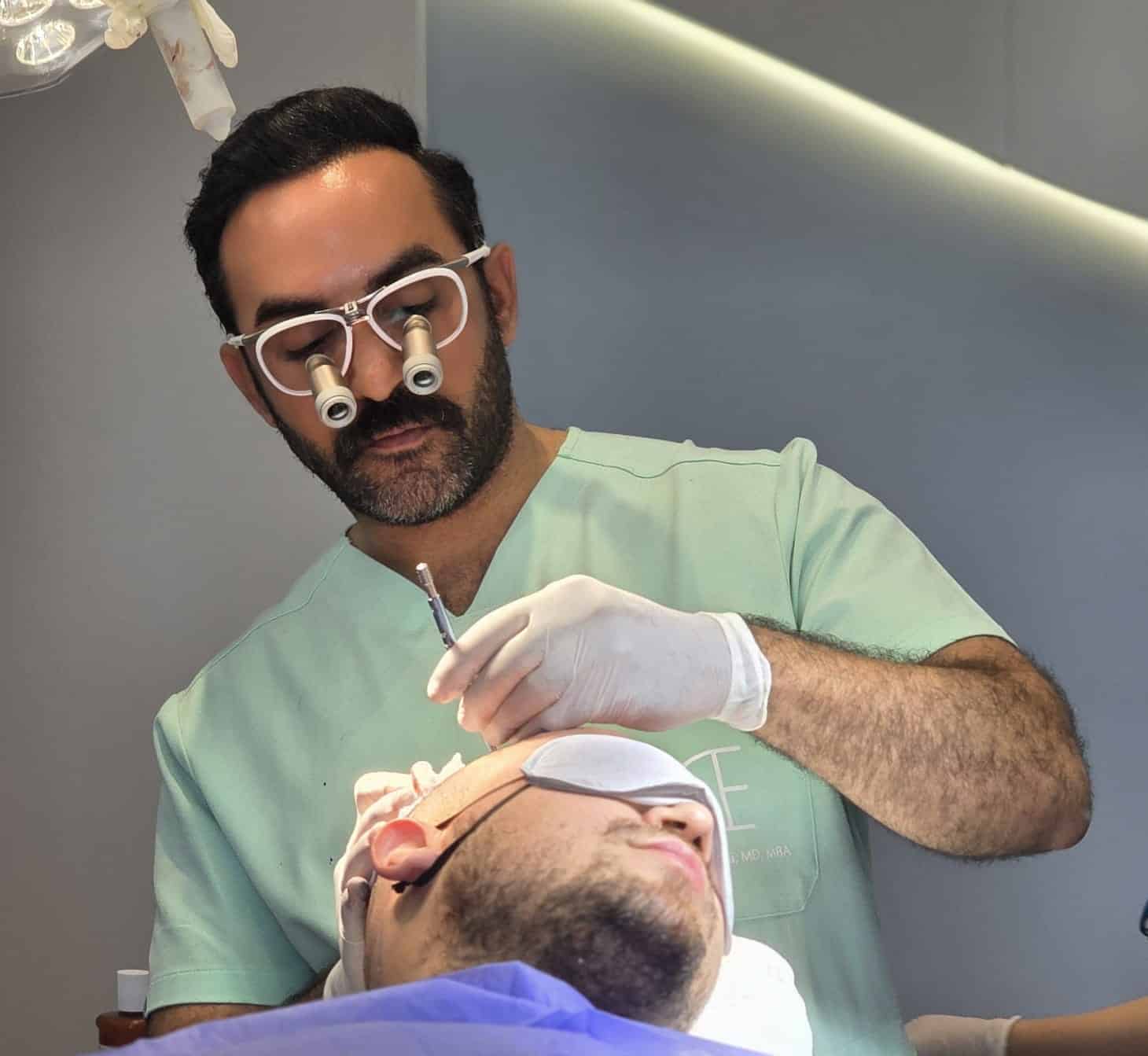 Written and reviewed by Dr Khalil El Cadhi, Full Member ISHRS, Medical Council reg. 026253 — updated 8 June 2026