
Beard
transplant.
Hair restoration of the beard area using FUE technique. Very low angles, direction adapted to facial growth, millimetric finishing. One of the most demanding procedures in hair restoration surgery.
★★★★★5.0 / 5 from 47 Google reviews 5-15° angles · facial growth
FUE applied
to the facial area.
Beard transplant is a FUE procedure applied to the facial area: follicles are harvested from the occipital fringe of the scalp — the same donor area used for standard hair transplants — then implanted on the beard zone according to a design agreed with the patient.
Three technical specificities distinguish it from a scalp transplant: very low implantation angles (5 to 15°) because beard hair grows almost parallel to the skin, variable direction by zone (chin, jawline, cheeks, moustache), and higher final density (40 to 50 follicles per cm²).
Reconstruction indications.
Beard alopecia
Congenital or acquired. Naturally sparse or fully absent beard.
Scars
Post-traumatic or post-surgical: cystic acne sequelae, burns, ENT or maxillofacial procedures.
Asymmetry or design
Targeted densification on one side to restore symmetry. Complete design of an absent beard. Gender transition patients.
Five steps,
5-15° angles.
- 01
Consultation and design
Comparative examination of donor hair and residual facial hair, precise contour design (classic style, full beard, goatee), graft-count calculation (typically 800 to 2,500).
- 02
Selective extraction
Occipital donor-area shaving to 1 mm. Extraction with fine micro-punch (0.7-0.8 mm) of mono or bi-follicular units only. 3-4 hair units set aside.
- 03
Facial anesthesia
Precise local facial anesthesia — maxillary and mandibular nerves selectively blocked, without touching the fine facial sensitivity.
- 04
Flat implantation
Recipient site creation at very low angle (5-15°) per mapped growth direction. Implantation with forceps or Choi pen by zone.
- 05
Final check
Reassessment of every follicle. No facial dressing — recipient area remains exposed. Duration 5 to 7 hours.
Seven milestones
over twelve months.
Visible regrowth
at 6-9 months.
The physiological shedding phase (shock loss) between weeks 2 and 6 is expected — grafted hairs fall, follicles enter telogen, then return to anagen. First stable results observable at 6-9 months, consolidated result at 12 months. The transplanted beard can be trimmed, shaved and brushed like a native beard.
Contraindications
Facial edema 3-7 days, transient bruising, scabs 7-10 days. No shaving for 2 weeks. Contraindications: non-stabilized alopecia areata, active lichen planopilaris, coagulation disorder, active local cutaneous infection.
From
€1 / graft
A full beard project typically represents 1,500 to 2,500 mono or bi-follicular grafts. Targeted densification: 500 to 1,000 grafts.
Common questions.
How many grafts for a full beard? +
1,500 to 2,500 mono- or bi-follicular grafts depending on desired density. Targeted densification may require only 500 to 1,000 grafts.
Do grafted hairs regrow after shaving? +
Yes. Transplanted follicles retain their normal biological cycle and continue producing hair for life. Transplanted beard can be shaved and trimmed like native beard.
At what age? +
Ideally from age 22-23, once natural facial hair has reached its maximum potential. An early transplant may become discordant if native beard continues to densify.
When can shaving resume? +
No shaving for the first 2 weeks. Light electric shaving at M+1, manual blade from M+2 provided no cutaneous irritation.
Ingrown hair risk? +
Low but possible risk, particularly in first months of regrowth. Rigorous hygiene and adapted topical care reduce this risk.
Outcome guarantees? +
No ethical hair restoration surgeon can guarantee a regrowth percentage — ISHRS rules forbid such claims.
Consult Dr El Cadhi
for a beard transplant.
Video consultation possible. Dr Khalil El Cadhi receives patients in person at the Dar El Hakim clinic in Djerba.
Request a consultation via WhatsApp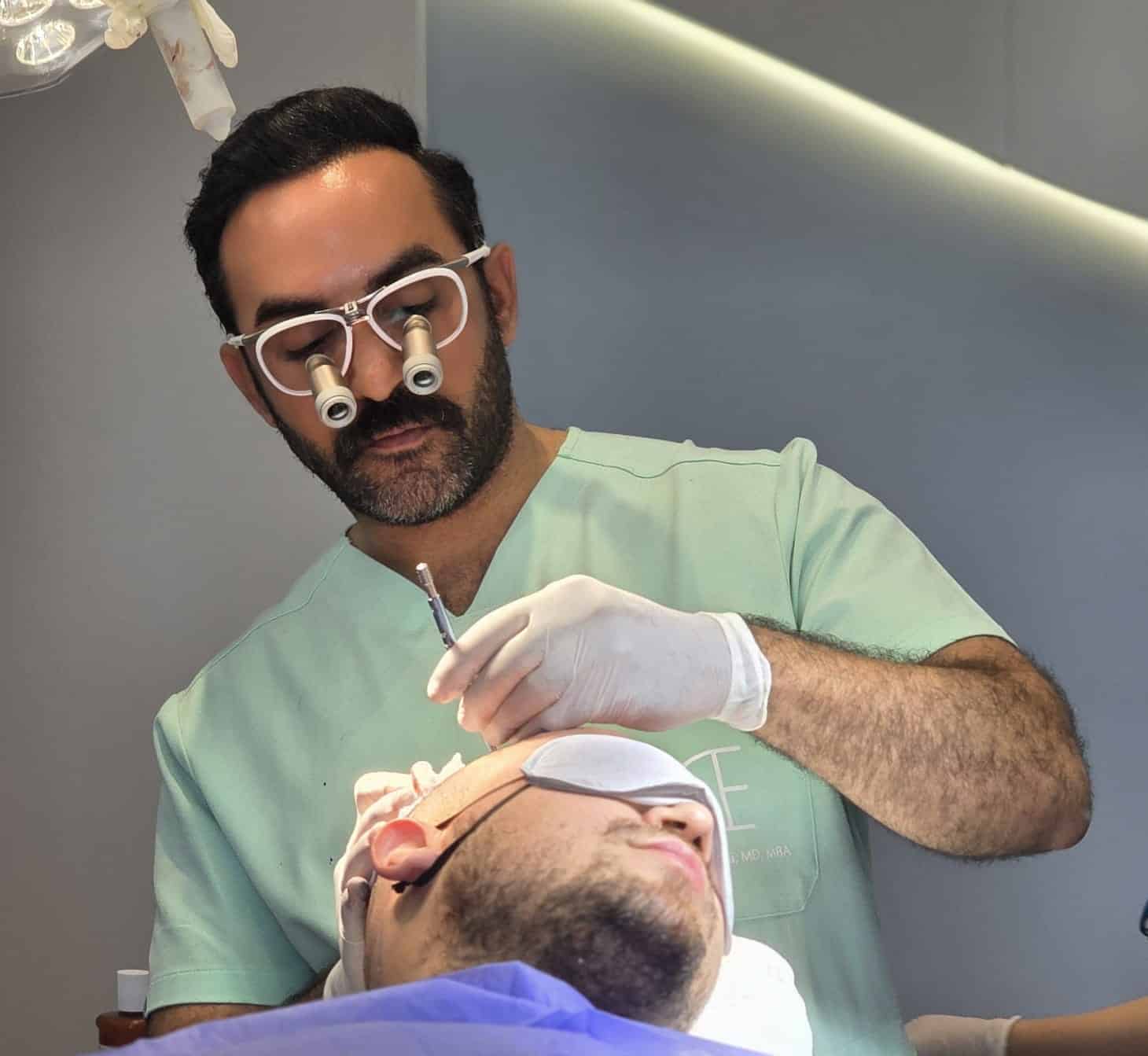 Written and reviewed by Dr Khalil El Cadhi, Full Member ISHRS, Medical Council reg. 026253 — updated 8 June 2026