
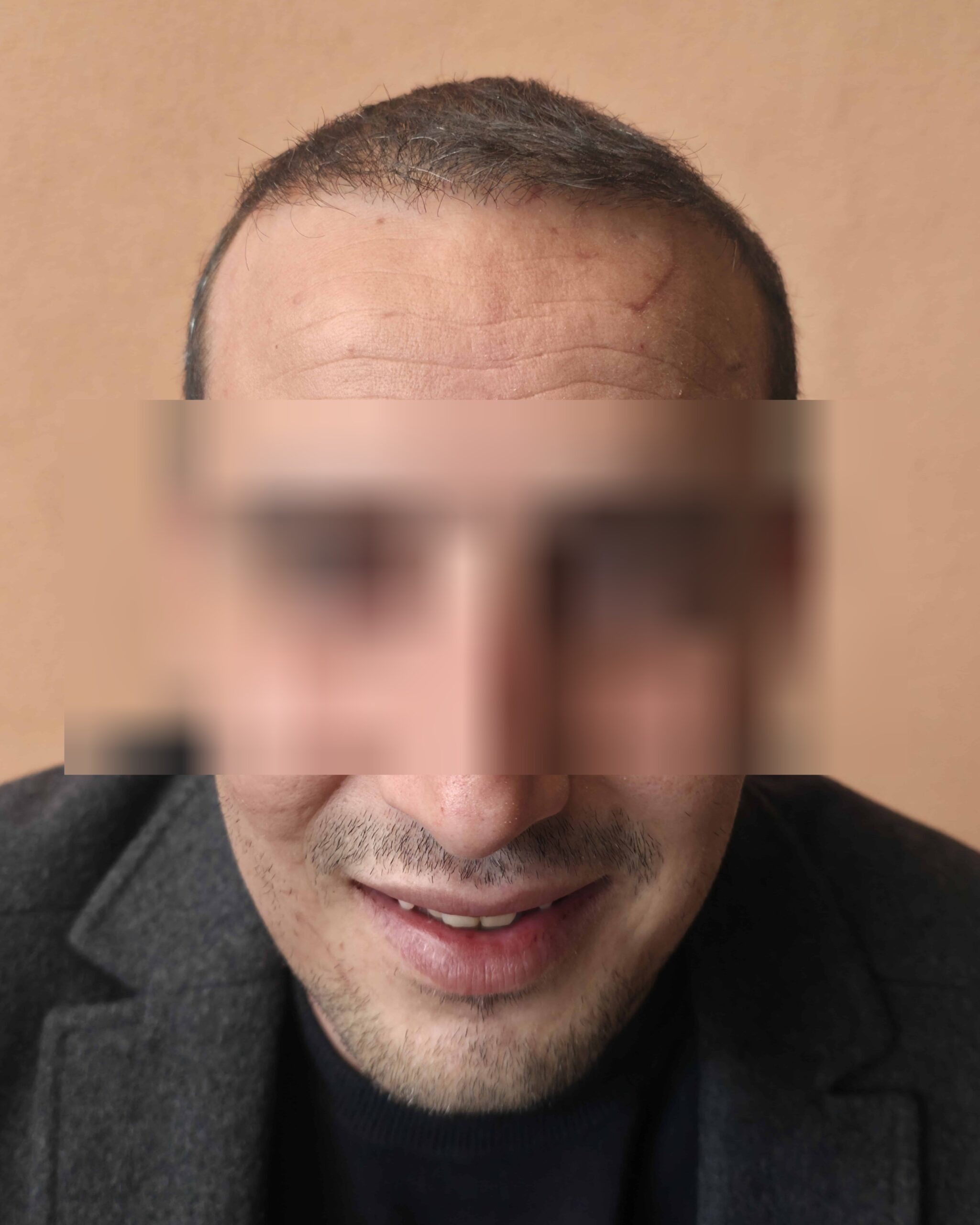
Long Hair FUE: see your result before surgery with ForceHT 3D simulation
Most patients considering a hair transplant share the same worry: committing to a result they won’t see for months. What if that logic could be reversed — visualising the hairline, density and direction of your hair before the first graft is placed?
That is exactly what the combination of three elements makes possible at Dr Khalil El Cadhi’s clinic in Djerba: Long Hair FUE (no-shave transplant), ForceHT 3D simulation and AI-assisted planning with ScalpScan.AI — all within the strict ethical framework of the ISHRS (International Society of Hair Restoration Surgery). This article explains, without unnecessary jargon, how these tools transform the preparation of a transplant — and why that preparation shapes how natural the result looks.
Long Hair FUE: keep your hairstyle the same day
Classic FUE usually requires shaving the donor area. Long Hair FUE — no-shave FUE — extracts and re-implants follicles without cutting your existing hair, so you can leave on the day of surgery with a normal-looking hairstyle.
It is a demanding technique: working on long hair reduces the surgeon’s visibility and demands great precision in the extraction angle. It remains mastered by a limited number of practitioners worldwide. Dr El Cadhi has integrated it as Preview Long Hair FUE: beyond the absence of shaving, the approach gives the patient an immediate read on the direction, density and angle of implantation.
Who is it for? Active patients who can’t show a shaved scalp, women for whom shaving is a deal-breaker, and anyone wanting a discreet transition.
ForceHT: see your result in 3D before deciding
One of the biggest sources of pre-surgery anxiety is aesthetic uncertainty. ForceHT, the 3D simulation software Dr El Cadhi relies on, addresses it: based on the patient’s morphology, it previews the hairline design, density distribution and hair orientation.
In practice, the simulation becomes a conversation. The patient no longer receives a plan — they co-create it with their surgeon, adjusting the hairline to their age and face shape, and understanding the trade-offs between desired density and available follicular reserve. This transparency is also an ethical requirement: a patient who understands their plan gives genuinely informed consent.
ScalpScan.AI: AI-assisted planning
A successful transplant rests on objective data: how many grafts are actually needed, and how should they be distributed? Dr El Cadhi relies on ScalpScan.AI, an AI-assisted scalp analysis tool, to support that planning. It assesses donor-area density, maps thinning zones and calculates the precise number of grafts to implant, area by area.
AI never replaces medical judgement here — it documents it. It turns a visual estimate into a traceable measurement, directly serving decision quality and follow-up over time. This is the very spirit of the evidence-based medicine that underpins Dr El Cadhi’s practice.
ISHRS ethics as a framework, not a slogan
Dr El Cadhi is a Full Member of the ISHRS, the leading scholarly society in hair restoration. That status implies experience criteria and a deontological commitment. For the patient, it translates into three principles: a consultation treated as a genuine medical act, surgery personally performed, and post-operative follow-up included in the care.
Ethics is also measured by what a practitioner refuses to promise. No result is presented as a foregone conclusion; each plan is matched to a real follicular reserve and to expectations that have been openly discussed. Over time, this methodological honesty is the best safeguard of satisfaction.
Why Djerba: proximity, language and precision
For patients from Europe and the Maghreb, Djerba combines rarely-united advantages: care in French and English, genuine proximity (direct flights from Paris in 2h15, Brussels 2h30, Geneva 2h00, Lyon 2h00), and pricing well below Western European clinics, from €1 per graft — a package including medication, consultation, PRP and 12-month follow-up.
Against Turkish or Spanish centres that often industrialise the patient journey, the approach here is deliberately personal: one surgeon, one patient, one considered protocol.
Patient results
A few recent results from the clinic. Drag the slider to compare before and after. Each case is unique; results vary from patient to patient.
Marwa — Long Hair FUE — day 1 — 1 500 grafts


Riadh — Long Hair FUE — day 1 — 1 200 grafts


Hammouda — Long Hair FUE — day 1 — 1 500 grafts


 BeforeAfter
Yanis — Long Hair FUE — 12 months — 1 600 grafts


 BeforeAfter

Atef — Long Hair FUE — 12 months — 1 800 grafts


Fehmy — Transplant repair — day 1 — 4 000 grafts


Frequently asked questions
Does Long Hair FUE leave visible scars?
FUE, shaved or not, leaves no linear scar like the strip technique. Micro-extractions are pinpoint and conceal naturally — even more so here since the hair is not shaved.
Is the procedure painful?
It is performed under local anaesthesia. Patient comfort is a protocol priority and is monitored throughout the session.
How long before I see the result?
The first permanent hairs appear around month 3–4; the result thickens progressively up to 12 months, during which follow-up is provided.
Can I know how many grafts I need without travelling?
Yes: from photographs, ScalpScan.AI analysis calculates the precise number of grafts to implant, then confirmed in consultation.
Book your consultation
Still unsure about feasibility or the number of grafts? The first step is a personalised consultation with a 3D simulation of your result.
📅 Book your consultation with Dr Khalil El Cadhi
🌐 drelcadhi.com · 📧 contact@drelcadhi.com
📱 WhatsApp: +216 21 933 000
📍 Dar El Hakim, Route Touristique, Houmt-Souk, Djerba 4180, Tunisia


